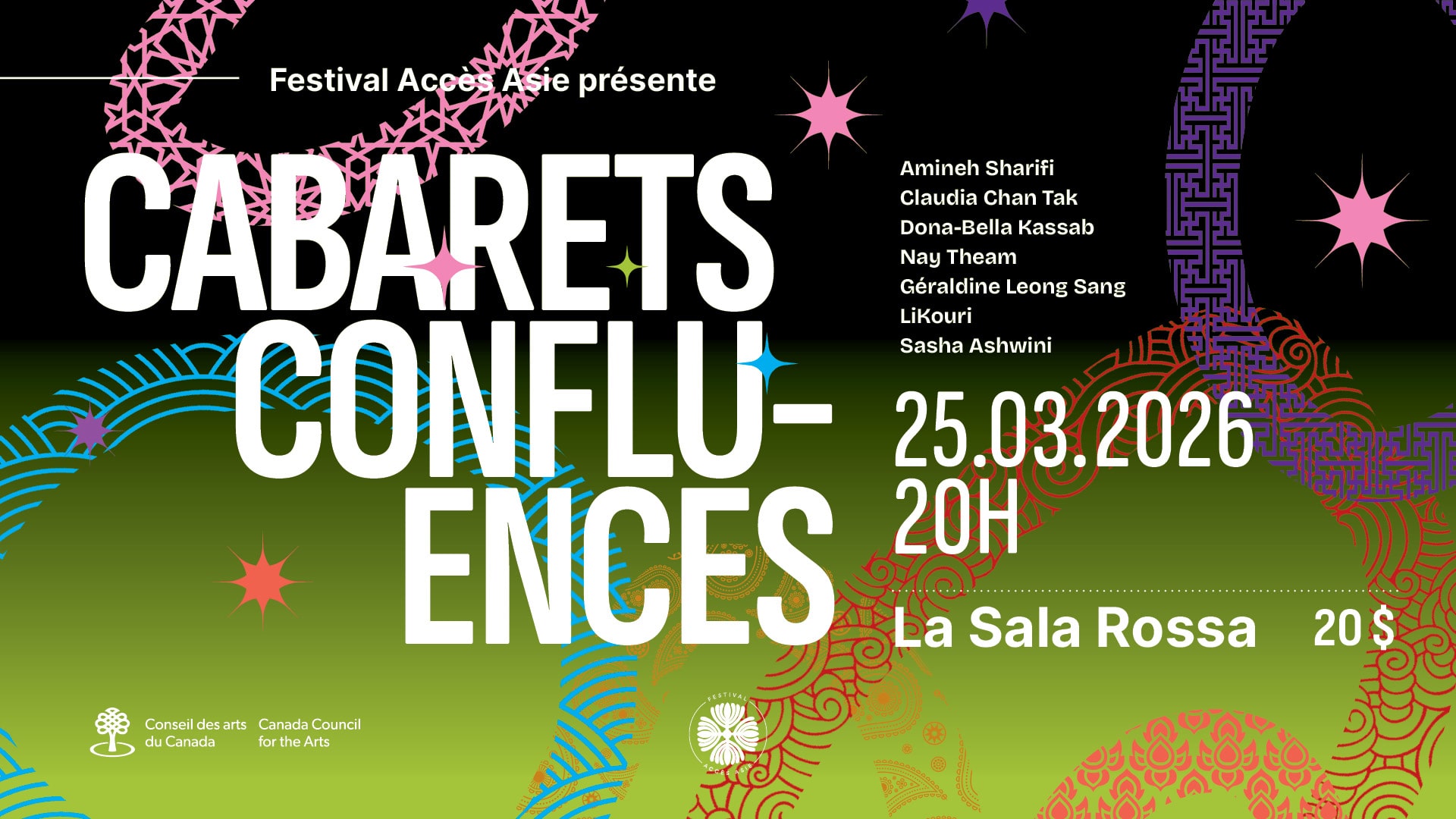
Cabaret Confluences #3
As part of the Week of Action Against Racism and for Equal Opportunity, Cabaret Confluences #3 features Amineh Sharifi with an excerpt from I Lost My Language, a bilingual French-Persian play exploring identity and language. This is followed by a trio blending poetry and music, composed of Claudia Chan Tak, Géraldine Leong Sang, and Nay Theam. Sasha Ashwini, a Bharatanatyam dancer, will explore themes of identity and decoloniality. LiKouri, a singer born in Canada whose mother is of Indian origin and was adopted by a Lebanese family, will share her musical creations.
Finally, Dona-Bella Kassab, MC and multidisciplinary artist, will close the evening.
Doors opening at 7PM. Show at 8PM.
Cabarets Confluences take the form of intimate, welcoming evenings featuring a variety of interdisciplinary performances, presented January 28, February 25 and March 25, 2026.
Amineh Sharifi | Theatre
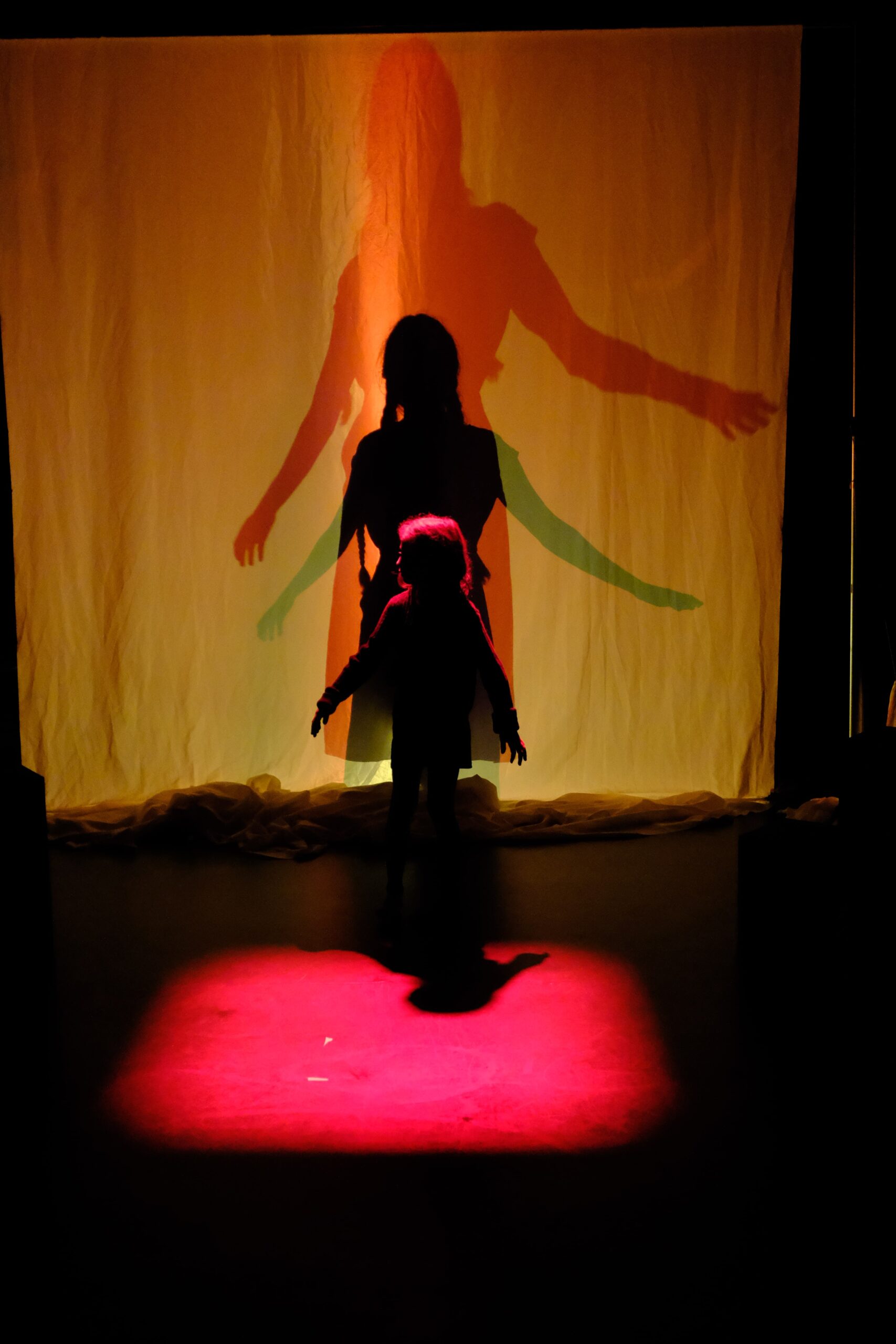
In this excerpt from the play J’ai perdu ma langue (translated for understanding as I Lost My Language), a little girl born into a mixed-race family does not speak her mother’s language. When she was younger, she was sung lullabies in that language. It is the memory of this comforting melody that opens the door to the world of dreams for the curious little girl as she waits for her grandmother to arrive from far away.
Set during the last days of winter and approaching Norouz, the spring equinox celebrated as New Year by Iranians, the play offers an encounter between two cultures for the audience and for the little girl in the story.
CREDITS
Text and Direction: Amineh Sharifi
Opening Nursery Rhyme: Amir Shadlou
Shadow Designer and Shadow Puppeteer: Mélina Kerhoas
Set Designer and Shadow Puppeteer: Elisabeth Bosquet
Lighting Designer: Rim Mohammad
Sound Designer: Frédéric Auger
Adult Performer: Madeleine Guastavino
Child Performer: Rachèle Hartmaan
Claudia Chan Tak, Géraldine Leong Sang, Nay Theam | Literature, Poetry, Dance, Theatre
While everything seems to be burning, how can we think about what shines in the distance? To heal wounds, we must first expose them.
Poetry, dance, and music intertwine in this journey through worlds of words and bodies. Nay Theam, accompanied by Claudia Chan Tak and Géraldine Leong Sang, reflects on failing memories, betraying recollections, and whispering voices.
Sasha Ashwini | Dance
Created in 2000 by Toronto-based choreographer Nova Bhattacharya, Maskura marks Bhattacharya’s pivotal transformation of Bharatanatyam into Canadian contemporary expression. A requiem shaped through movement and original music by Ed Hanley, the solo explores mourning, memory, and celebration, revealing the expansive potential of a dancing body reimagined by bridging tradition and innovation with rigor and restraint.
LiKouri | Music
Ziya is a performance that moves between fairy-tale storytelling, chamber music, and French chanson. It will carry you to the shores of the St. Lawrence, between our grandmothers’ carpets and the scents of childhood. Meant for dream-filled souls, it invites wonder and contemplation.
LiKouri, accompanied by five talented musicians, weaves a world where melodies and words intertwine to tell a story infused with poetry and hope. Together, they lead you on a sensory, intimate journey where music becomes a bridge between past and present.
Amineh Sharifi
Amineh Sharifi is an Iranian-born artist, voice actress (in Persian), author, and director (theater). She entered the world of art through voice acting: after studying computer engineering, she discovered her voice in Tehran and trained at the Association of Young Voice Artists, where she began lending her voice to characters and stories.
Arriving in Canada in 2010, she continued writing and performing radio plays in Persian, creating a fictional character whose daily chronicles were broadcast in Iran for five years. She also gave performative readings in Persian and completed studies in education, which led her to work in Montreal schools.
Since 2022, Amineh has been more involved in the French-speaking theater community. Interested in poetry, language, and sensory forms, she has adopted shadow theater, movement, and objects as her creative vocabulary. Her approach is built on collaboration and engagement with the audience, who are involved early on in the process. Her recent show in development, J’ai perdu ma langue (I Lost My Language), has been supported by the Canada Council for the Arts, the Quebec Arts Council, and the Montreal Arts Council.
Claudia Chan Tak
Claudia Chan Tak is a multidisciplinary Quebecois artist of Malagasy-Chinese origin, trained in visual arts (Concordia University, Bachelor with distinction, 2009) and contemporary dance (UQAM, Bachelor 2012 & Master 2017). Her artistic and activist journey is deeply rooted in the promotion of Asian communities, which she advocates for through her projects.
She is recognized for her work as a choreographer, performer, actress, costume designer, and videographer. To highlight the quality of her artistic work, she received the very first Kesar Grant in 2025, after being awarded the Mécènes Investis pour les arts Prize in 2018 and the William Douglas Prize in 2015. In addition to participating in artistic juries and organizing numerous events—including the renowned Asian Open Mic—she was a member for two years of the Coalition Asiatique pour une Relève Émancipatrice (CARÉ), a collective that received the Paul-Gérin Lajoie Diversity Award 2020–2021. In 2022, she was honored with the prestigious Prix Envol, awarded by the Prix de la danse and the Conseil des arts de Montréal, in recognition of her artistic, community, and curatorial practice that values cultural diversity and inclusive practices.
Dona-Bella Kassab
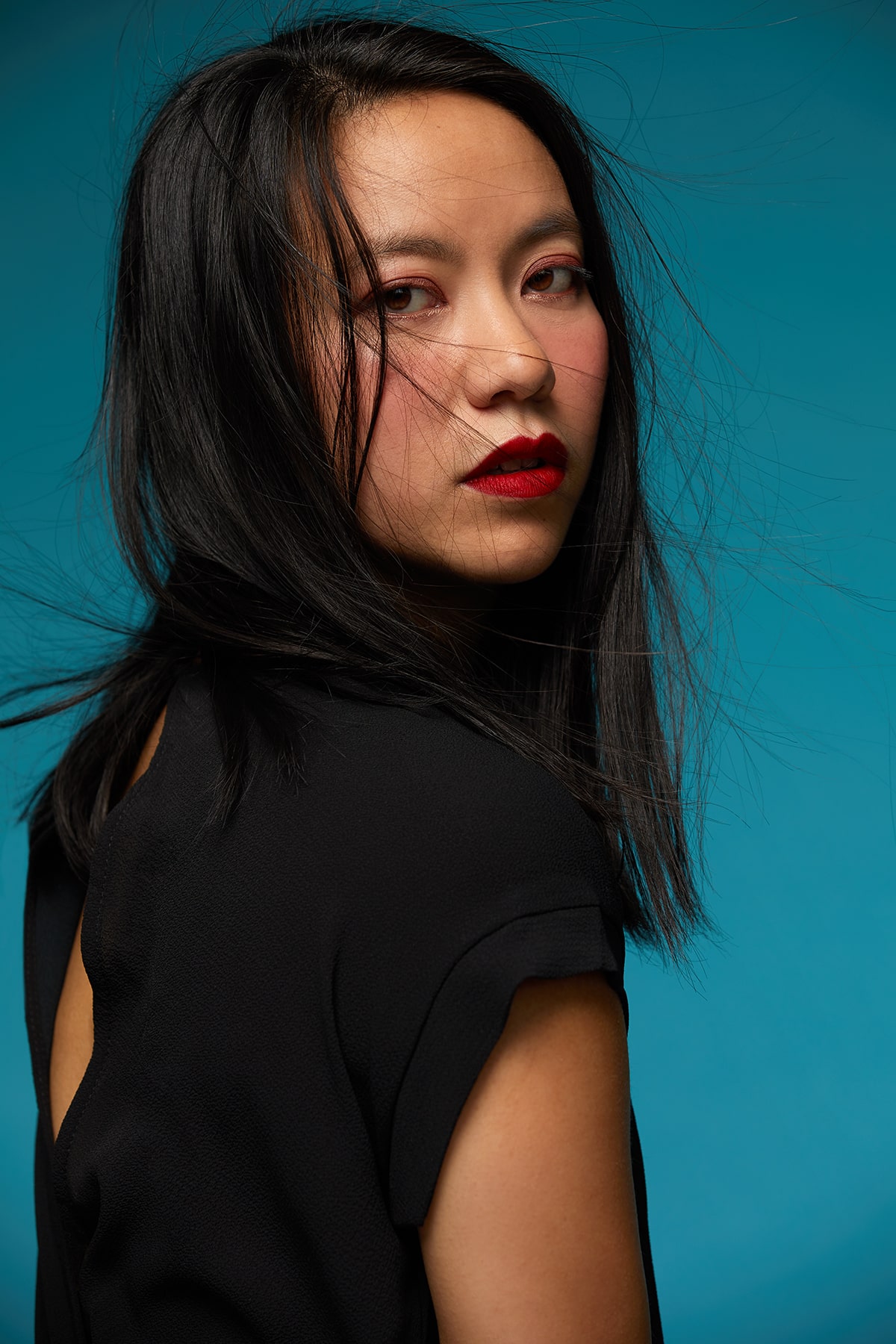
A performing artist, Dona-Bella possesses a powerful and unique stage presence. Performer, actress, dancer, playwright, director, writer—versatility is essential in her practice of interdisciplinary arts. In addition, the artist is exploring punking/whacking, butoh, cabaret-jazz, circus, physical theater, masks, and buffoonery. Their creations have been presented at various festivals, including Jamais Lu, Entractes, Mossy Fae, Festiqueer, and Post-Furies. Known for their raw authenticity, effervescent creativity, and grand ambitions, their themes revolve around shame and storytelling.
Among their collaborations: Tout Feu Tout Femme, Baobab, Code Universel, Temps public, Teesri Dunya, Montréal Arts Interculturels, as well as with artists such as Chanel Cheiban, Marie-Ève Milot, Mireille Tawfik, Nicolas Cantin, Penelope Gromko, and Brie-Ana Laboucane. Their guiding principle: spaces that promote human and artistic integrity. Iel performs in interpretation, but also in punking/whacking, cabaret-jazz, butoh, acrobatics, and contemporary dance.
Among their creations are SOS Belle Femme (2020), Sous le Voile de la Bienséance (2021), Rage et Amour (2023), and Songe d’un jour d’hiver (2024), recently performed at the Entractes Festival in Montreal.
Géraldine Leong Sang
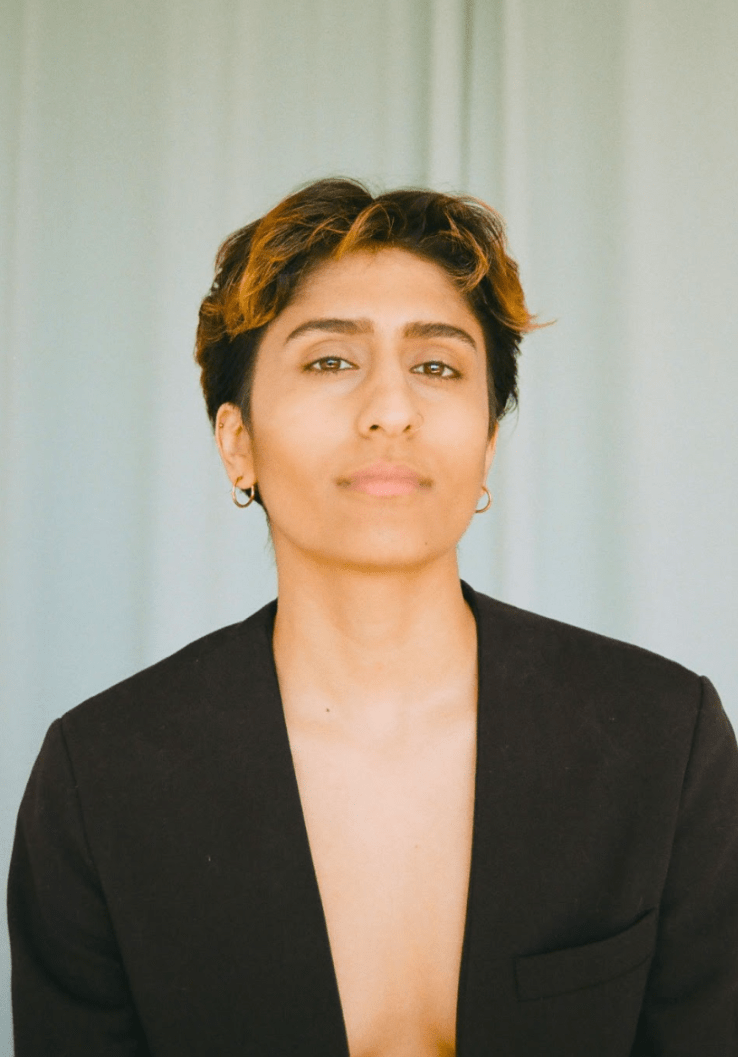
Géraldine Leong Sang discovered dance at the age of seven and chose to make it her path when she encountered contemporary dance within the RARY company in Madagascar, where she worked as a performer, teacher, and administrative manager. In 2011, she founded the company JINY, and the following year launched the multidisciplinary platform Perf’impro.
She moved to Quebec in 2020. The following year, a school-based residency grant from the Conseil des Arts de Longueuil enabled her to create her solo Ma. An excerpt was presented at the Festival Quartiers Danses in 2022, and the work was completed in July 2023 during a residency at Salon 58 in Marsoui, organized by Mandoline Hybride. Ma was later presented in Saint-Lambert as part of Présences Inouïes, a project initiated by Dena Davida.
She also collaborated with Jasmine Dubé of the theatre company Les Bouches Décousues on a staged reading of Marguerite in 2021 and again in 2023.
Since 2023, she has contributed to various artistic projects by Claudia Chan Tak, taking on roles such as outside eye, performer, rehearsal director, and assistant choreographer.
She also participates regularly in the Open Mic Asiatique, where she improvises alongside participating artists.
LiKouri
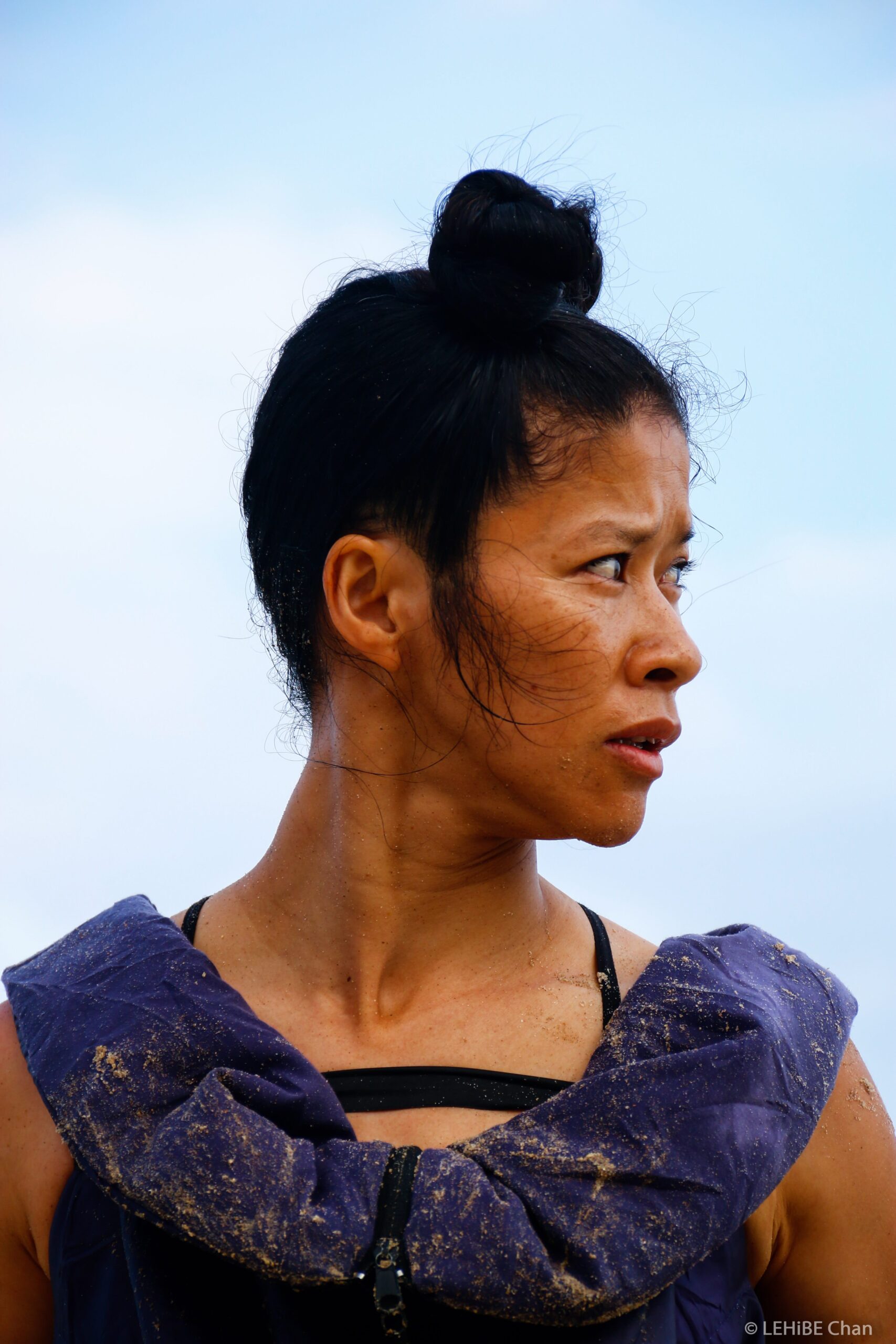
LiKouri is a Montreal-based singer-songwriter who grew up immersed in various artistic environments, nurturing from a young age a passion for creation and for developing multidisciplinary projects. She grew up in Montreal, where she discovered her love for the performing arts. LiKouri later moved to the Côte-Nord region, where she taught herself the accordion and composed her first songs.
Her self-titled project was born in 2021. Since then, the ensemble has recorded two albums: the first, AZA, and ZIYA, released in August 2024. Accompanied by five talented musicians, LiKouri has performed across Quebec. This small orchestra is composed of Isabelle Gaudreau on clarinet, Enzo Lors Mariano on bandolim, Laetitia Francoz Lévesque on violin, Zachary Bernatchez on cello, and Emilou Johnson on double bass.
Winner of the 2024 MUZ cohort with Vision Diversité, she continues to travel throughout Quebec to present her show. Through her deceptively simple compositions, she creates a blend that evokes another era. LiKouri is a bold artist, seeking musical growth off the beaten path while remaining accessible to contemporary audiences and weaving in traditional influences.
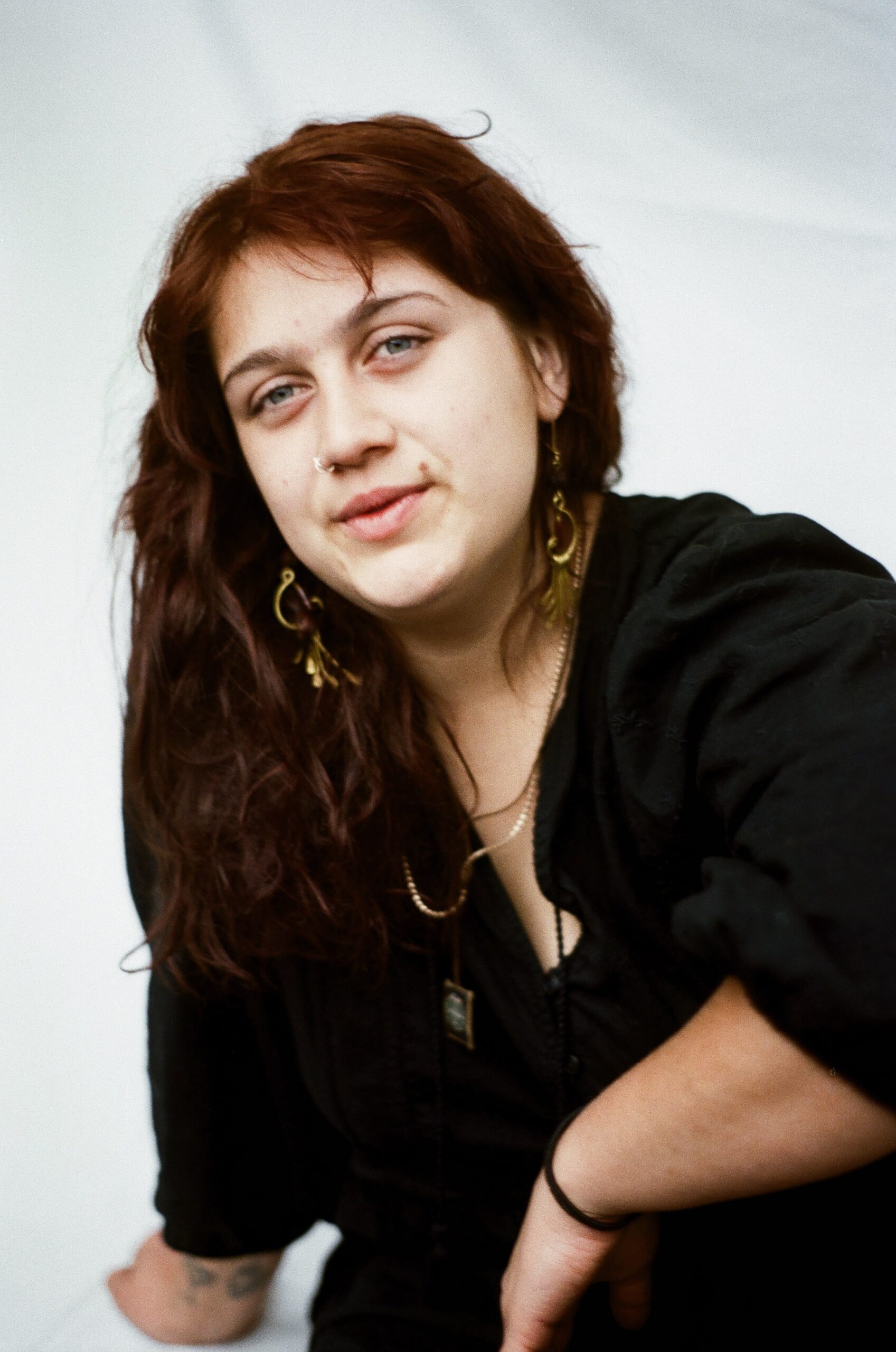
Nay Theam
Nay Theam has been writing poetry for over ten years and occasionally shares her work. Of Cambodian origin, born in Quebec City, she still speaks a little Khmer, but mainly speaks French. She teaches literature at CEGEP in what she considers to be a decolonial approach. Trained in literature, she is beginning doctoral studies on the relationship to the northern territory in Innu, Atikamekw, and Southeast Asian literature. Her artistic practices are part of a writing of memory. Poetry intimidates her less than before, and she likes to tell her family history in bits and pieces. Her writings have been published in Littoral magazine (2024 and 2025) and others will appear in l’Estuaire (2026).
She performs regularly at Asian open mics organized by Claudia Chan Tak and Rich Ly, and in 2025, she co-organized a special edition with them at Collège de Maisonneuve. She was a guest artist at the Asian open mic at the Centre du théâtre d’aujourd’hui in 2024.
She directs the Lire, voir et écouter l’Asie (Read, See, and Listen to Asia) project, which seeks to promote Asian perspectives in educational settings through various outreach activities. She recently organized (Re)lire le Cambodge (Rereading Cambodia), a literary journey focusing on several stories by Cambodian authors written in French.
Her work is part of a desire to give a voice to marginalized communities. Because existing is essential.
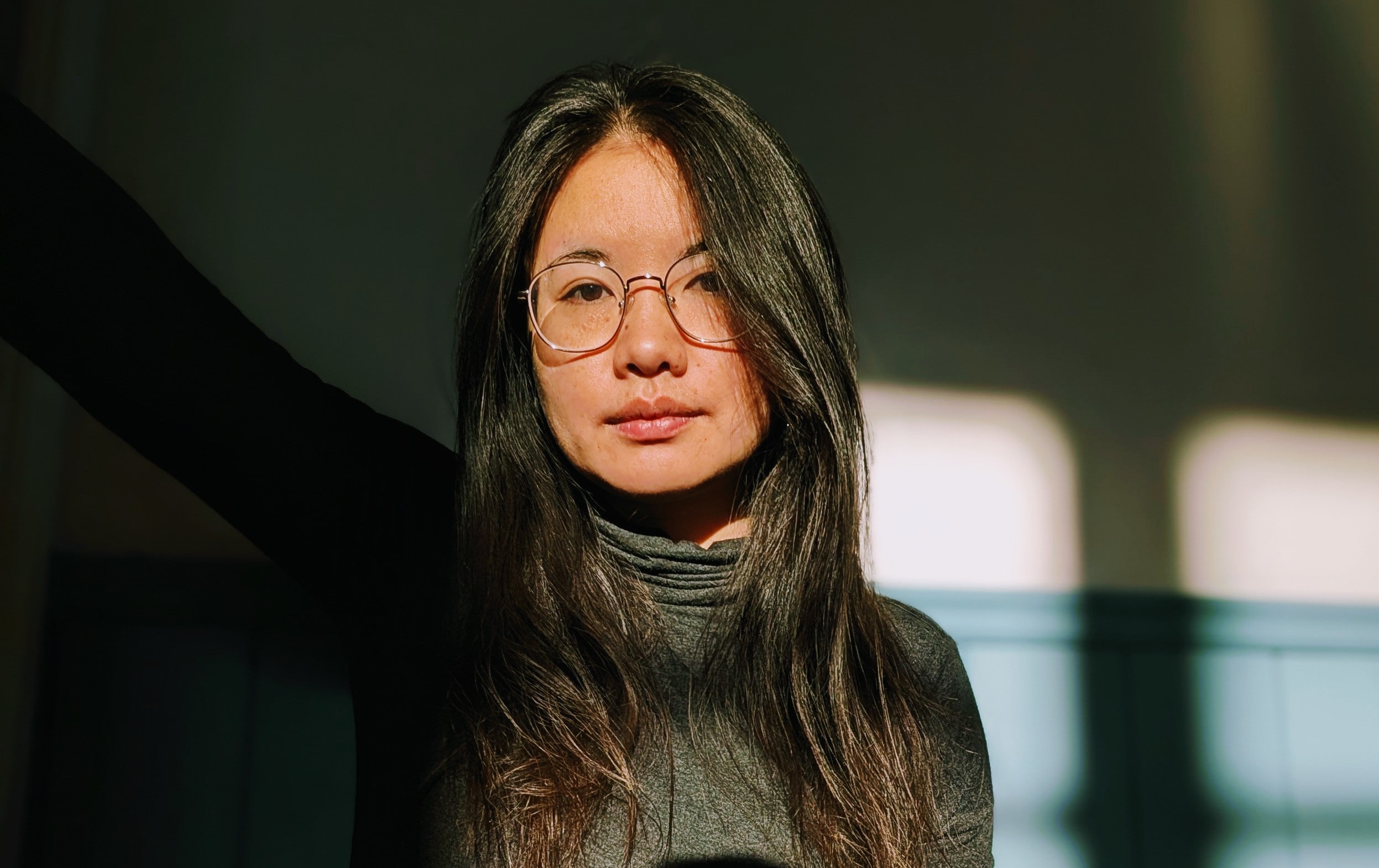
Sasha Ashwini
Sasha Ashwini is a contemporary dance artist specializing in bharatanatyam. Her diverse upbringing as a fourth-generation Indian-Singaporean and first/second-generation Canadian has deeply influenced her creative research on migration, its stresses, and its transformations. Ashwini’s collaborative and solo works have been presented by prominent organizations, including Tangente, the Dancing on the Edge Festival, CanAsian Dance, and the Dance Centre, among others. She remains a disciple of the acclaimed bharatanatyam danseuse Rama Vaidyanathan, whose artistry is widely regarded for its spiritual depth and ability to bridge tradition with a transcendent experience. This focus on spiritual resonance and the pursuit of inner truth deeply influences Ashwini’s own practice, as she seeks to carry this sacredness into her performances, creating a dialogue between tradition, identity, and personal transformation. Currently in development, her solo work CROSSING DEEP WATERS explores the layered terrain of identity shaped by what is lost, carried, or transformed across geographies and generations. Ashwini has been honoured by DanceHouse and the Hawthorne Foundation in April 2025 for receiving the second-place prize for the Louise Bentall Award for Emerging Choreographers.
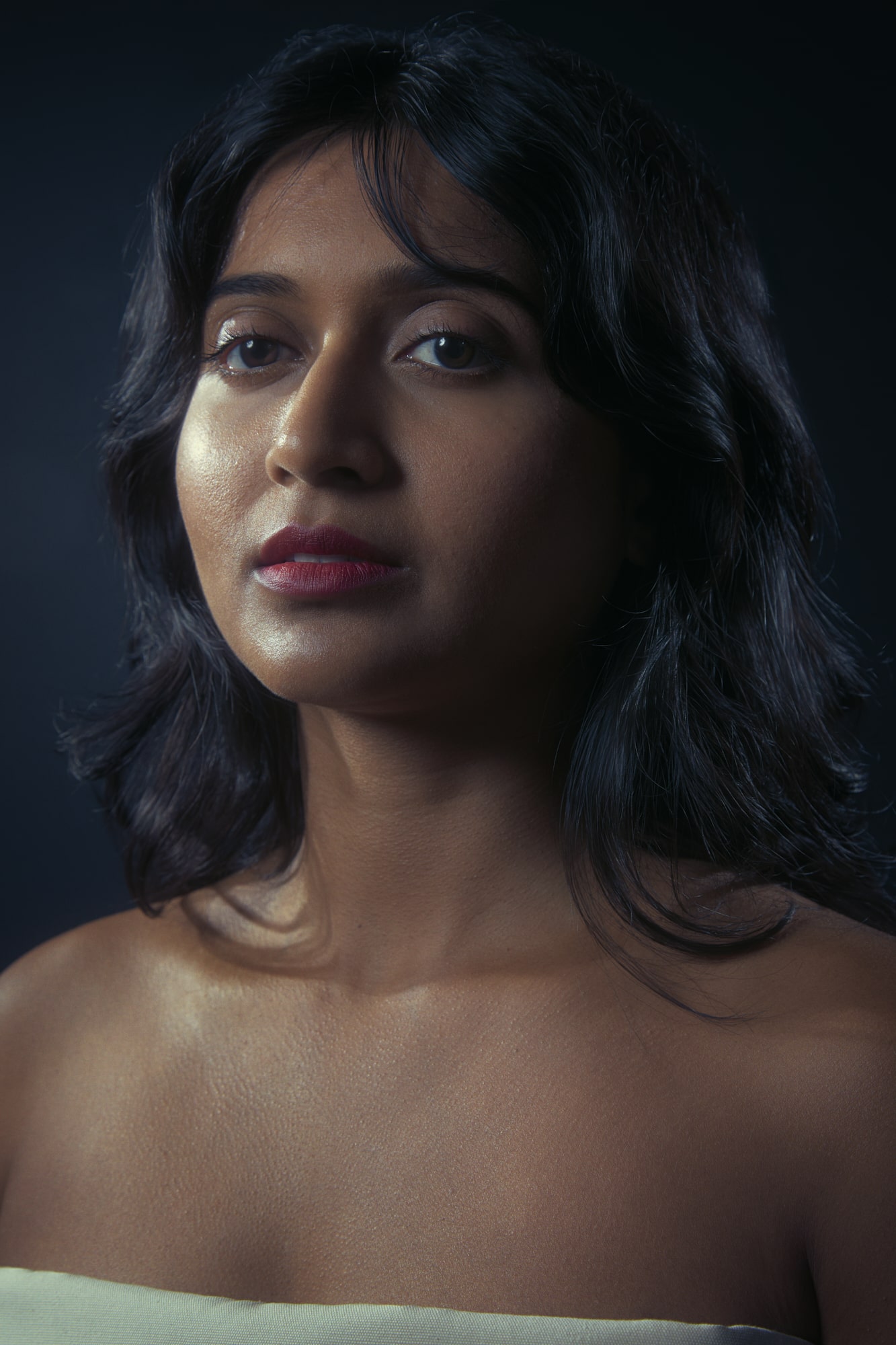
Disciplines
Dance
Interdisciplinary Art
Literature
Performance Art
Music
Poetry
Theatre
